
Reviewed · HISTORICAL TOURS
Kuala Lumpur Colonial History Walk – Private Guided Tour
Kuala Lumpur’s colonial center packs an astonishing number of landmarks into a walkable area. This private tour links railway stations, mosques, churches, government buildings, river crossings, and Central Market into one clear story of how the city grew.
I like the personal guide and the small scale, limited to your party of up to four. I also like the way the route mixes famous buildings with less noticed places such as the former Government Printing Office and the old railway headquarters. The main drawback is that you’ll spend three to four hours on foot in Kuala Lumpur’s heat, with no meal or bottled water included.
Key points to know before you book

- A compact route with a big historical payoff: The walk covers the old civic center without requiring long transfers between sights.
- Private attention for up to four people: Your guide can shape the pace and explain details that large groups often miss.
- Architecture is the star: Railway buildings, colonial offices, religious buildings, and civic monuments reveal different sides of old Kuala Lumpur.
- The Klang and Gombak rivers matter: Their meeting point explains the city’s name and its original setting.
- Central Market provides a useful finish: You end near shopping, food, and public transport rather than at an isolated landmark.
- Plan for the weather: Wear comfortable shoes, bring water, and expect a moderate level of walking.
Why this Kuala Lumpur walk feels different
This is not a quick sweep past Kuala Lumpur’s postcard buildings. The route uses architecture as a doorway into the city’s past, with attention to railway expansion, colonial administration, religion, trade, and local leadership.
Your guide handles the connecting story. That matters here because many of the buildings sit close together but represent very different institutions. A former railway office, an Anglican cathedral, a mosque, a bank, and a government complex can otherwise feel like unrelated photo stops.
The experience is private, so your group of up to four people gets the guide’s full attention. Past bookings have featured guides named Priam and Pritam, both praised for clear storytelling and careful explanations of the buildings. Since the tour depends on the guide’s presentation, this personal format is a major part of the value.
The route takes about three to four hours. That is long enough to develop a real sense of place, but short enough to fit into a half-day in Kuala Lumpur. It is best scheduled when you have energy for walking and can still enjoy the city afterward.
More Historical Tours in Kuala Lumpur
- Kuala Lumpur: Batu Caves & Historic Buildings Tour
★ 4.7 · 539 reviews - From Kuala Lumpur: Private Batu Caves Cultural Tour
★ 4.4 · 410 reviews - Private Half-day Batu Caves and Cultural Tour Kuala Lumpur *2026*
★ 5.0 · 165 reviews
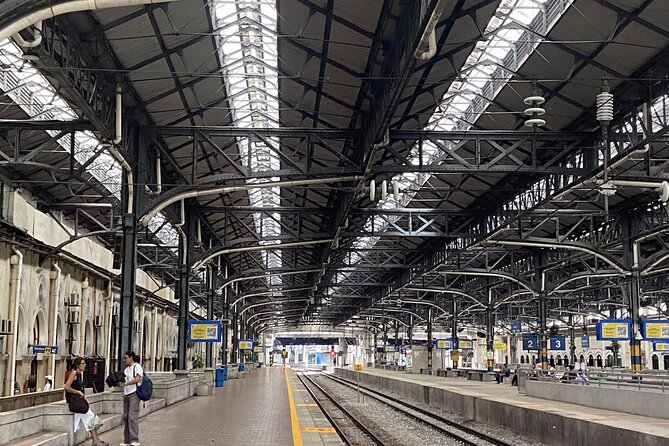
Starting at Kuala Lumpur Railway Station
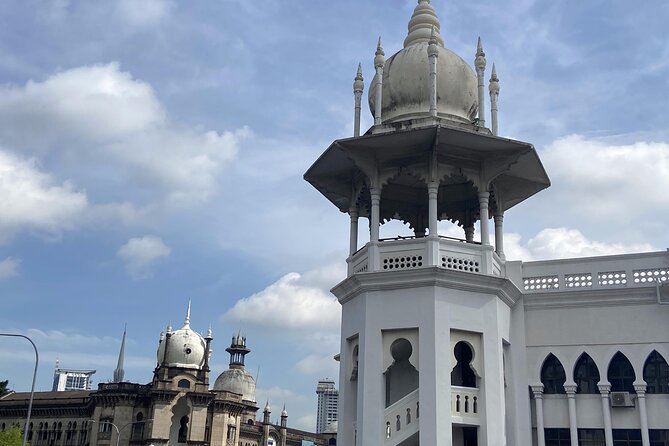
The tour begins at Kuala Lumpur Railway Station on Jalan Sultan Hishamuddin. Built in the grand style associated with the British-era railway system, the station is one of the most striking buildings on the route.
Its white exterior, domes, arches, and minaret-like details give it a storybook appearance. The design is often linked with Indo-Saracenic architecture, a style used across British colonial India and Malaya. You get about 15 minutes here, enough to examine the exterior and hear why the station made such an impression on early visitors.
I like starting here because railways explain Kuala Lumpur’s growth better than a general city introduction. Rail connections helped link mining areas, plantations, and port towns, turning Kuala Lumpur into a major administrative and commercial center.
The station is still a working transport landmark, but this walk focuses on its design and history rather than a railway ride. Admission is free, and your guide supplies the context.
Across the road at the Malayan Railway Administration Building
A short walk brings you to the former Federated Malay States Railway Administration Office. Designed by government architect Arthur Benison Hubback, the building reflects the same taste for elaborate arches, domes, and detailed façades.
Construction began in 1914, three years after the station. The 10-minute stop helps you compare the two buildings and see how the railway system required more than tracks and platforms. It also needed offices, engineers, administrators, and a central authority.
This is a good example of why a private guide helps. The building may not be as instantly familiar as the railway station, yet it explains how transportation and government worked together during the colonial period.
The stop is brief, so expect an exterior explanation rather than a long interior visit. Like the other landmarks, it has no admission charge.
Following the Klang River toward the old city
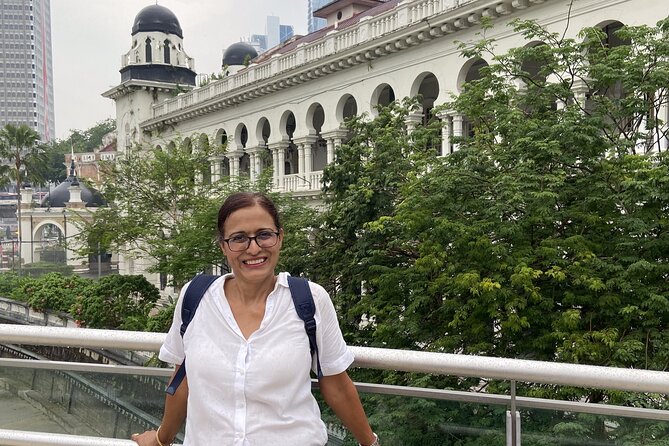
The route then connects with the Klang River, one of Selangor’s major waterways. The river runs for about 120 kilometers, rising in the Titiwangsa range before passing through Kuala Lumpur and continuing toward the Straits of Malacca.
The river is not just scenery. Its course helps explain why the settlement developed where it did, and it remains part of the city’s geographic identity. You’ll also hear how the city’s name relates to the muddy meeting point of the Klang and Gombak rivers.
This section gives the walk some welcome geographic balance. You are not only looking upward at façades. You are also seeing the water routes and terrain that shaped early settlement, trade, and expansion.
More Walking Tours in Kuala Lumpur
- Kuala Lumpur Local Street Food Private Walking Tour by Night
★ 4.5 · 224 reviews - Kuala Lumpur: Nightlife Walking Tour with Local Guide
★ 5.0 · 33 reviews - Half Day Cultural And Heritage Walking Tour in Kuala Lumpur
★ 5.0 · 28 reviews - Kuala Lumpur InfoFun Walking Tour Experience
★ 5.0 · 24 reviews
Old Market Square and the 1937 clock tower
At Old Market Square, the route pauses at an elegant clock tower erected in 1937 to mark the coronation of King George VI. The tower was designed by Arthur Oakley Coltman, another architect associated with Kuala Lumpur’s colonial civic center.
You get about 10 minutes here. That may sound short, but the square works best as part of the wider story. It shows how public spaces were used for ceremony and imperial symbolism, while nearby buildings handled government, commerce, worship, and transport.
The stop also offers a useful contrast with the earlier railway buildings. The railway station celebrates movement and connection. The clock tower marks authority and public ceremony.
Jamek Mosque at the city’s birthplace
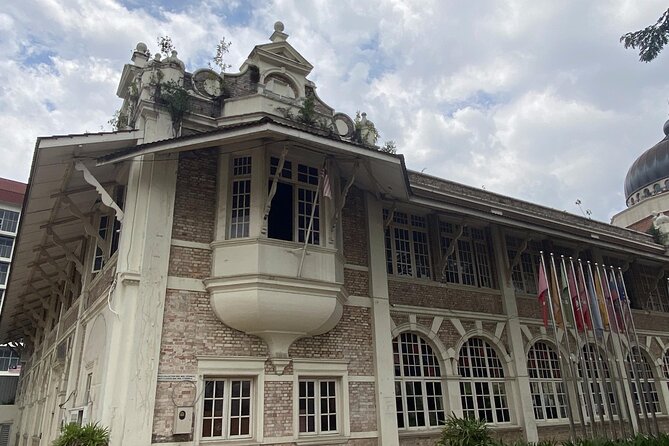
Jamek Mosque is one of the most meaningful stops on the walk. It sits at the confluence of the Klang and Gombak rivers, the place tied to Kuala Lumpur’s name and early development.
The name Kuala Lumpur refers to a muddy estuary or confluence. Seeing the mosque at this location makes the city’s origin easier to understand than reading the words on a map.
The mosque receives about 15 minutes. Your guide explains its setting and architectural importance, but you should remember that it is an active place of worship. Dress and behavior should be respectful, and access can depend on religious observance and site conditions.
I especially like this stop because it keeps the tour from becoming a purely British-colonial story. Kuala Lumpur’s identity was shaped by Malay Muslim life, Chinese mining and trade, Indian communities, river commerce, and British administration. Jamek Mosque brings one essential part of that story to the center.
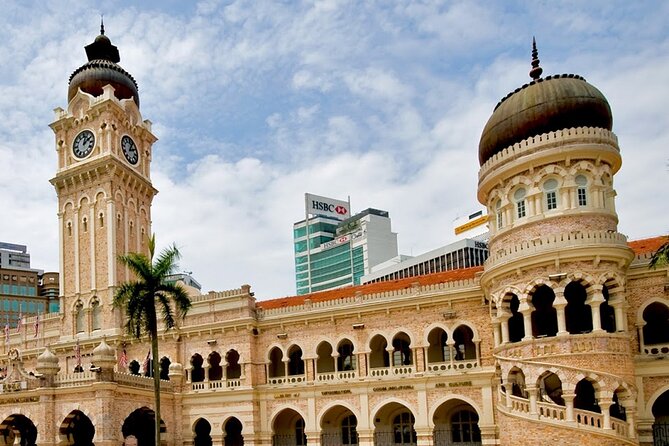
Sultan Abdul Samad Building and Merdeka Square
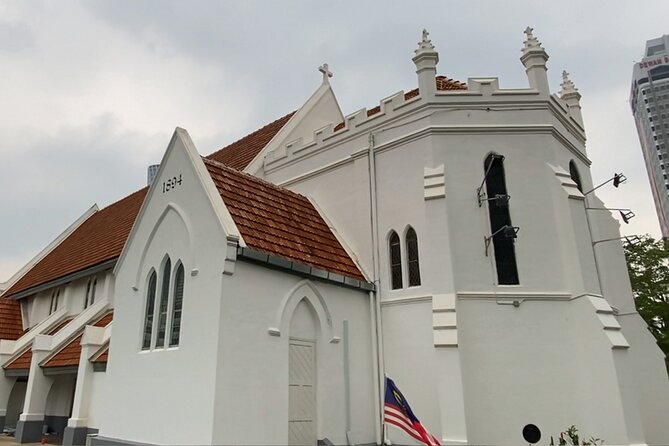
The Sultan Abdul Samad Building is the tour’s grand civic centerpiece. Constructed in 1894 for the British colonial administration, it once housed government offices and is now one of Kuala Lumpur’s best-known historic façades.
Its clock tower, domes, arches, and long frontage make it easy to understand why this area became the city’s ceremonial core. The building is flanked by the former General Post Office, Magistrate Courts, and Kuala Lumpur Council Building, creating a large group of related colonial structures rather than a single isolated monument.
The stop lasts about 15 minutes. Use that time to look beyond the central façade. The neighboring buildings help you see how administration operated as a network of offices, courts, postal services, and local government.
This is also the area where Kuala Lumpur’s colonial past meets modern Malaysian national history. The nearby field, commonly associated with independence ceremonies, gives the architecture a second layer of meaning. Your guide can help separate the colonial purpose of the buildings from their later place in Malaysia’s national story.
St. Mary’s Cathedral and the old social order
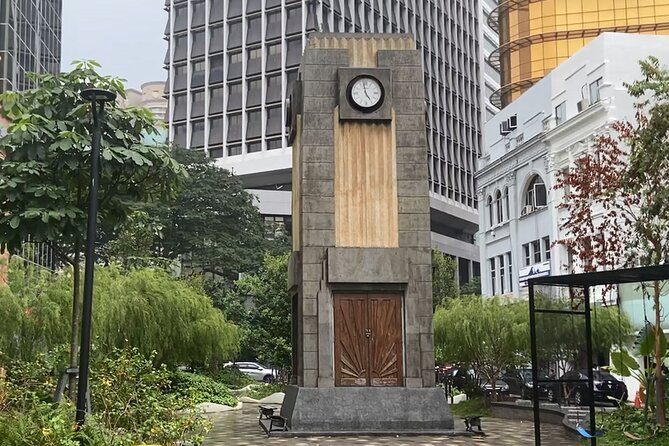
St. Mary’s Cathedral offers a quieter change of mood. The Anglican church began as a modest timber building in 1887 on nearby Bukit Aman hill. The present brick structure replaced it in 1895.
You get about 15 minutes here. The building helps explain the religious and social institutions that accompanied British administration. It also gives the route architectural variety after the larger government complex.
The church should be viewed with the same courtesy as Jamek Mosque. It is a religious building, not simply a backdrop for photographs. The tour’s value lies in seeing how different communities built places of worship within the same compact district.
Nearby, the Selangor Club adds another piece of the old colonial social scene. Founded in 1884, it became a meeting place for educated and high-ranking members of colonial society. Early membership was largely British, though admission was linked more to education and social standing than nationality alone.
That detail matters. Colonial history is not only a story of buildings and officials. Clubs, schools, churches, and social networks helped shape who had influence and access.
The former Government Printing Office
The Kuala Lumpur Library grounds contain the former Government Printing Office, completed in 1899. This building once produced government reports, official books, and public notices.
It receives about 10 minutes on the walk. The stop may be less immediately dramatic than the Sultan Abdul Samad Building, but it explains how colonial administration communicated and preserved its authority.
I like this kind of inclusion. A city’s past is not made only by grand monuments. Printed regulations, reports, and notices helped make government visible in everyday life. The building also gives you another example of how many historic structures are tucked into ordinary modern surroundings.
The old Chartered Bank building on Jalan Ampang
At 2 Jalan Ampang, you’ll see a building completed in 1909 for the Kuala Lumpur branch of the Chartered Bank of India, Australia and China, later associated with Standard Chartered.
The bank was founded in London in 1853. Its Kuala Lumpur branch points to the financial networks behind colonial commerce. Banks supported trade, government payments, investment, and the movement of money across the British Empire.
The stop lasts about 10 minutes. It is a useful reminder that Kuala Lumpur’s development involved finance as well as mining, railways, and administration.
You may find the building less visually famous than the railway station or mosque, but the guide’s explanation gives it weight. Without that context, an old bank can look like just another attractive façade.
Queen Victoria Fountain and the old railway office
The Queen Victoria Fountain sits near the Selangor Club Padang. It was shipped from Britain to commemorate Queen Victoria’s diamond jubilee in 1897, though it was not assembled on site until later.
That delay gives the monument an amusing practical detail. Imperial ceremony could arrive in pieces and wait before finding its place in the city.
The route then reaches the old FMS Railway Office, the first headquarters of the Federated Malay States Railways. This building marks the shift from separate state railways toward a unified system. Malaya’s first railway line opened in 1885 between Taiping and Port Weld.
The 10-minute stop links neatly back to the tour’s opening at Kuala Lumpur Railway Station. You can now see the railway not only as a beautiful station but as an institution that changed how the region functioned.
Finishing at Central Market
The final stop is Central Market, where you have about 30 minutes. Its story begins in 1888, when Kapitan Yap Ah Loy is associated with the creation of a humble wet market. It later developed into a larger hall of commerce.
This is a practical and satisfying ending. After several hours of colonial civic buildings, Central Market brings you back to trade, food, shopping, and daily urban life. It also connects Kuala Lumpur’s early commercial activity with the city you see today.
The tour ends here, just a short walk from the starting area. Central Market is convenient for continuing your afternoon, finding a meal, or taking public transport back to your hotel.
The market stop is longer than most of the architectural pauses. That gives you room to look around rather than simply receive a history lesson and leave.
What the $45 price gets you
At $45 per person, the price is easiest to judge by group size. The experience is private for up to four people, so a couple or small family gets individual attention without joining a large walking group. Group discounts may also be available.
There are no major attraction admissions to absorb the cost. The fee mainly pays for the guide’s time, research, printed material, route planning, and storytelling. That is good value if you want the buildings explained rather than simply photographed.
The price is less compelling if you only want a quick orientation or prefer to explore independently. Most stops are free, and the route is compact. The tour earns its keep through interpretation, not ticket access.
Wear comfortable shoes and bring bottled water, since water and meals are not included. The required fitness level is moderate, and the walk can feel more demanding in hot or humid weather.
Who should book this walk?
I would choose this tour if you enjoy architecture, city history, and stories about how institutions shaped a place. It is especially useful early in a Kuala Lumpur visit because the route gives you a clear map of the old center.
It also suits couples, families, and small groups who want a flexible conversation with a guide. The private format is helpful if you have questions or want to spend more time on a particular building.
You may want something else if you dislike walking, need frequent indoor breaks, or are mainly looking for food and shopping. Central Market is included at the end, but the main focus is history and architecture.
The best booking window appears to be about 30 days ahead on average. Free cancellation is available up to 24 hours before the start time, which gives you some useful flexibility.
Should you book the Kuala Lumpur Colonial History Walk?
Book it if you want Kuala Lumpur’s old center to make sense as a connected story. The railway station, river confluence, mosque, government quarter, cathedral, bank, railway office, and market are much more interesting when you understand how they fit together.
Skip it if you want a short photo tour or a route with meals and indoor attractions. For most history-minded visitors, though, the private format and compact route make $45 a reasonable price for a focused half-day with a guide such as Priam or Pritam.
FAQ
How long does the Kuala Lumpur Colonial History Walk last?
The walking tour lasts approximately three to four hours.
Where does the tour begin?
It begins at Kuala Lumpur Railway Station, at 110 Jalan Sultan Hishamuddin, Kampung Attap, Kuala Lumpur.
Where does the tour end?
The tour ends at Central Market in Kuala Lumpur City Centre.
Is the tour private?
Yes. Only your group participates, with a maximum of four people.
What is the price?
The listed price is $45 per person. Group discounts are available.
Are admission tickets included?
Admission fees are included, and the listed stops have no admission charge.
Are meals included?
No. Meals are not included.
Is bottled water provided?
No. Bottled water is not included, so you should bring your own.
What physical fitness level is required?
A moderate level of physical fitness is recommended because this is a three to four-hour walking tour.
Can I cancel for a full refund?
Yes. You can cancel up to 24 hours before the experience start time for a full refund. Cancellations or changes made less than 24 hours before the start are not accepted for a refund.
Just added around Kuala Lumpur
- Walk & Discover KL’s Architectural and Heritage Gems★ 5.0 · 7 reviews
- Private Transfer: Kuala Lumpur International Airport to or from Hotel★ 4.5 · 14 reviews
- Transit Tour Private Tour (Ex Port Klang Cruise Centre/KLIA 1 &2)★ 5.0 · 10 reviews
- Private Port Klang Cruise to Kuala Lumpur City Tour★ 5.0 · 3 reviews
- Private Kuala Lumpur Shore Excursions★ 4.5 · 22 reviews
- Kuala Lumpur City & Batu Caves Temple Private Tour★ 4.5 · 3 reviews
- Kuala Lumpur International Airport Transfers★ 5.0 · 4 reviews
- Kuala Lumpur International Airport Layover Tour★ 4.0 · 12 reviews
Historical Tours, compared.
Historical Malacca Guided Day Tour (Shared Tour)
Read our review →
Historical Malacca Day Tour from Kuala Lumpur (Private Tour)
Read our review →
Private Half-day Batu Caves and Cultural Tour Kuala Lumpur *2026*
Read our review →
Malacca Historical Private Tour With Personal Chauffeur
Read our review →Browse the lists this tour appears in